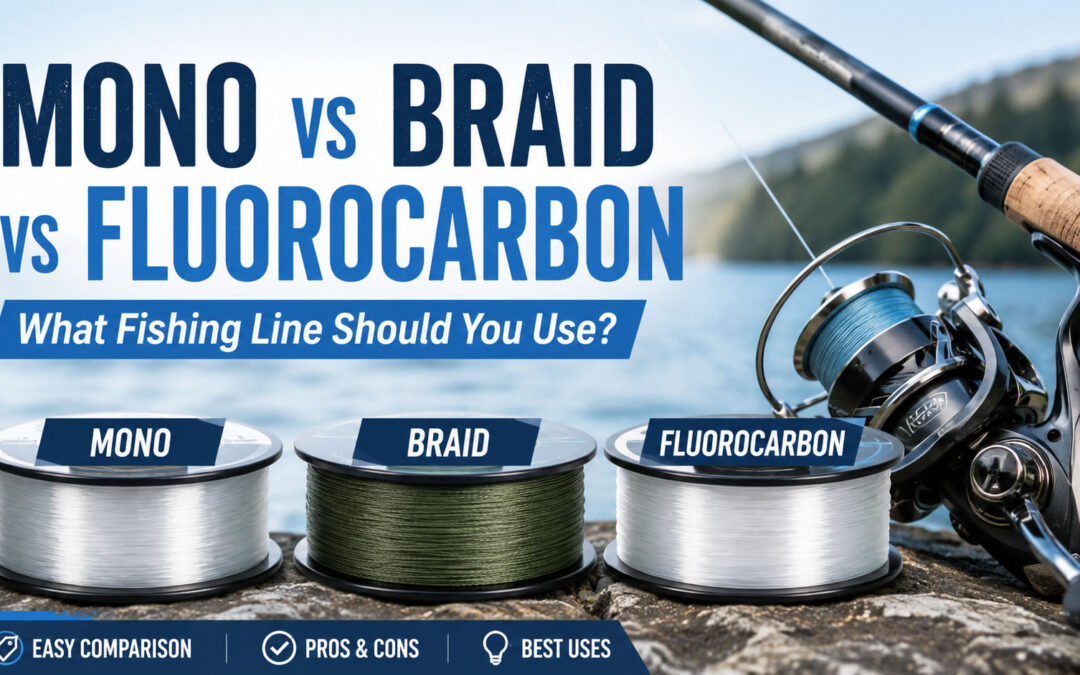
Mono vs Braid vs Fluorocarbon: What Fishing Line Should You Use?
Choosing fishing line can feel more confusing than picking a rod or reel. You walk into a tackle shop and see monofilament, braided line, fluorocarbon, leaders, different pound tests, different colors, and dozens of brands all claiming to be the right choice.
The truth is simpler than it looks.
Most anglers only need to understand three main types of fishing line: monofilament, braid, and fluorocarbon. Each one has a different purpose. Monofilament is easy to use and beginner-friendly. Braided line is strong, thin, and sensitive. Fluorocarbon is harder for fish to see and works well around rocks, docks, shells, and clear water.
Once you understand the difference between mono, braid, and fluorocarbon, it becomes much easier to match your line to the type of fishing you want to do.
Quick Answer: Mono vs Braid vs Fluorocarbon
The best fishing line depends on how and where you fish. Monofilament is the best all-around fishing line for beginners because it is affordable, easy to tie, and forgiving. Braided line is best when you need more strength, longer casts, and better sensitivity, especially for bass fishing, surf fishing, pier fishing, and heavy cover. Fluorocarbon is best for clear water, leader material, and situations where fish may be line-shy. For most anglers, the best setup is simple: use mono for easy everyday fishing, braid when you need power and distance, and fluorocarbon when you need a low-visibility leader.
Fishing Line Comparison Chart
| Fishing line type | Main advantage | Main drawback | Good choice for |
|---|---|---|---|
| Monofilament | Easy to use and affordable | More stretch and thicker diameter | Beginners, panfish, trout, catfish, topwater |
| Braided line | Strong, thin, and sensitive | Very visible in clear water | Bass, surf fishing, pier fishing, heavy cover |
| Fluorocarbon | Low visibility and abrasion resistance | Stiffer and more expensive | Leaders, clear water, trout, bass, structure |
What Is Monofilament Fishing Line?
Monofilament fishing line, often called mono, is made from a single strand of nylon. It has been one of the most popular fishing lines for decades because it is simple, affordable, and works in a wide range of situations.
If you are new to fishing, monofilament is usually the easiest place to start. It handles well on spinning reels, ties easily, and gives you enough stretch to absorb sudden pulls from a fish.
That stretch can be helpful. When a bass jumps, a catfish rolls, or a trout makes a quick run, mono gives slightly instead of staying completely tight. That little bit of forgiveness can help prevent hooks from pulling free.
Mono also works well for basic bait fishing, bobber fishing, pond fishing, lake fishing, and casual freshwater trips. It is a great choice for bluegill, crappie, trout, small bass, perch, and smaller catfish.
Pros and Cons of Monofilament
Pros:
Monofilament is easy to manage, especially for beginners. It is not as expensive as braid or fluorocarbon, so replacing old line does not cost much. It also knots well and works with many common fishing knots, including the improved clinch knot, Palomar knot, and uni knot.
Another benefit is that mono floats more than fluorocarbon. That makes it useful for topwater lures, floating bait presentations, and bobbers.
Cons:
Mono has more stretch than braid or fluorocarbon. While stretch can be helpful, it can also make it harder to feel light bites. This is especially true when fishing deep water, long casts, or soft bites from finicky fish.
Monofilament is also thicker than braid at the same pound test. Thicker line can reduce casting distance and may be more visible in clear water.
It can also weaken over time from sunlight, heat, and wear. If your mono looks cloudy, curled, brittle, or frayed, it is time to respool.
When Should You Use Monofilament?
Use monofilament when you want a simple, dependable line that works for many types of fishing.
Mono is a good choice for:
- Beginner fishing setups
- Bluegill and panfish
- Crappie
- Stocked trout
- Catfish
- Topwater lures
- Live bait
- Bobber fishing
- Pond and lake fishing
- General freshwater use
For a basic spinning rod, 6–10 lb monofilament is a great starting point.
Best Time to Fish Bogue Inlet Pier
The best time to fish Bogue Inlet Pier is usually early morning, late afternoon, and during a moving tide. Fish often feed better when water is moving because bait is pushed along the beach and around pier structure.
Incoming tide can bring cleaner water and bait closer to the pier. Outgoing tide can create current and feeding opportunities around nearby cuts, channels, and the inlet area.
Spring, summer, and fall are usually the most active seasons. Summer can bring bluefish, Spanish mackerel, pompano, sea mullet, sharks, and other warm-water species. Fall can be excellent for drum, bluefish, sea mullet, and other migrating fish. Emerald Isle Fishing Report
What Is Fluorocarbon Fishing Line?
Fluorocarbon fishing line is known for being harder to see underwater than other types of fishing line. It is denser than monofilament, sinks faster, and holds up well around rough surfaces.
Many anglers use fluorocarbon as leader material rather than filling an entire reel with it. This is especially common when using braided line as the main line.
Fluoro is useful in clear water, around pressured fish, and near structure such as rocks, docks, shells, bridge pilings, and oyster beds. It is also popular for bass fishing, trout fishing, jig fishing, worm fishing, and bottom presentations.
Pros and Cons of Fluorocarbon
Pros:
Fluorocarbon is less visible underwater, which can help when fish are cautious or the water is clear. That makes it a smart option for trout, bass, and other fish that may shy away from obvious line.
Fluoro also has good abrasion resistance. If your line rubs against rocks, shells, wood, or dock posts, fluorocarbon can give you a better chance of landing the fish.
Because fluorocarbon sinks, it works well with many subsurface lures and bottom presentations. Worms, jigs, crankbaits, and soft plastics are all common fluoro applications.
Cons:
Fluorocarbon is more expensive than mono and can be harder to manage, especially in heavier pound tests. It is stiffer, which means it may coil or jump off a spinning reel if you use too much or spool it poorly.
It can also be less beginner-friendly than monofilament. For that reason, many people use a short fluorocarbon leader instead of using fluorocarbon as their main line.
When Should You Use Fluorocarbon?
Use fluorocarbon when you need a less visible line or extra toughness near rough cover.
Fluorocarbon is useful for:
- Clear water
- Trout fishing
- Bass fishing with jigs or soft plastics
- Leader material
- Fishing around rocks, shells, and docks
- Finicky fish
- Bottom rigs
- Situations where abrasion resistance matters
A braid-to-fluorocarbon setup is one of the most versatile combinations in modern fishing.
Best Fishing Line for Trout
Trout often live in clear water and can be cautious, so lighter line usually works better.
For stocked trout, 4–6 lb monofilament is a good basic choice. For wild trout, clear streams, or heavily pressured fish, a fluorocarbon leader can help.
If you are fishing small spinners, trout magnets, salmon eggs, worms, or small flies with spinning gear, light line will usually get more bites than heavy line.
Best Fishing Line for Surf Fishing
Surf fishing often requires long casts, strong line, and the ability to handle waves, current, sandbars, and larger fish. That is why many surf anglers use braided line.
A common surf setup is 20–30 lb braid with a monofilament or fluorocarbon leader. Braid helps with casting distance, while the leader adds abrasion resistance near the rig.
If you are casting heavy sinkers, you may need a heavier shock leader. If you are throwing lures for bluefish, Spanish mackerel, or red drum, braid with a leader is a very popular option.
Mono can still work in the surf, especially for beginners, but braid usually gives better distance and sensitivity.
Should You Use a Leader?
A leader is a short piece of line tied between your main line and your hook, lure, or rig. Leaders are usually made from monofilament or fluorocarbon.
If you use braided line, a leader is often a good idea. Braid is strong and sensitive, but it is also visible and can struggle around sharp structure. A leader helps solve both problems.
Use a fluorocarbon leader when the water is clear, fish are spooky, or you are fishing near rocks, shells, docks, or pilings.
Use a monofilament leader when you want a little more stretch, a lower cost, or a simple bait-fishing setup.
For many anglers, braided main line with a fluorocarbon leader is the most versatile setup.
Common Fishing Line Mistakes
One common mistake is using line that is too heavy. Heavy line can reduce casting distance, make small lures move unnaturally, and cause fewer bites in clear water.
Another mistake is leaving old line on a reel for too long. Fishing line wears down from sunlight, heat, knots, fish, rocks, and general use. If it looks rough or feels weak, replace it.
Poor knots also cause many lost fish. Even strong fishing line will fail if the knot is weak or tied incorrectly. Learn a few reliable knots and practice them until you can tie them confidently.
Good knots to learn include:
- Improved clinch knot
- Palomar knot
- Uni knot
- Double uni knot
- Loop knot
Finally, check your line often. The few feet closest to the hook or lure take the most abuse. If you feel nicks, frays, or rough spots, cut that section off and retie.
What Is Braided Fishing Line?
Braided fishing line is made from woven synthetic fibers. It is much thinner than monofilament at the same strength rating and has very little stretch.
That combination makes braid powerful and sensitive. You can cast it far, feel bites clearly, and set the hook with authority, even at a distance.
Braid is popular with anglers who fish heavy cover, long casts, deep water, surf, piers, docks, bridges, grass, lily pads, or structure. It is commonly used for bass fishing, surf fishing, pier fishing, inshore saltwater fishing, frog fishing, and jig fishing.
Because braid is thin for its strength, you can fit more line on a reel. That is helpful when casting from the beach, fishing from a pier, or targeting fish that may make long runs.
Pros and Cons of Braided Line
Pros:
The biggest strength of braid is sensitivity. Since it has very little stretch, you can feel bumps, taps, weeds, rocks, and bottom changes better than you can with mono.
Braid also offers excellent strength in a thin diameter. That helps with casting distance and gives you more power when pulling fish away from grass, brush, docks, pilings, or other obstacles.
Another advantage is durability. Braid can last longer on a reel than mono, especially if you take care of it and occasionally reverse it on the spool.
Cons:
The main weakness of braid is visibility. In clear water, fish may notice it more easily than mono or fluorocarbon. That is why many anglers tie on a fluorocarbon or monofilament leader.
Braid can also be slippery, so knot choice matters. Poor knots may slip under pressure. The Palomar knot is a popular choice for tying braid directly to a lure, while the double uni knot, Alberto knot, or FG knot can be used to connect braid to a leader.
Another thing to watch: braid can cut your hands if you pull on it hard. Never wrap braided line around your bare fingers when trying to free a snag.
When Should You Use Braided Line?
Use braided line when strength, casting distance, and sensitivity matter most.
Braid is a strong choice for:
- Bass fishing in grass, pads, or heavy cover
- Surf fishing
- Pier fishing
- Inshore saltwater fishing
- Frog fishing
- Jig fishing
- Long-distance casting
- Fishing around docks and bridges
- Situations where you need to feel light bites
For many anglers, braid works best as a main line with a mono or fluorocarbon leader.
Which Fishing Line Is Best for Beginners?
For most beginners, monofilament is the best choice.
A spinning reel filled with 6–10 lb mono is simple, affordable, and useful in many fishing situations. You can use it for bluegill, crappie, trout, small bass, perch, and general pond or lake fishing.
Mono is also easier to untangle than braid, easier to cut than fluorocarbon, and more forgiving while learning how to cast, tie knots, adjust drag, and fight fish.
A good beginner setup might look like this:
| Rod | Medium-light or medium spinning rod |
|---|---|
| Reel | 2500 or 3000 size spinning reel |
| Line | 6–10 lb monofilament |
| Best for | Panfish, trout, small bass, general freshwater fishing |
Once you get comfortable, you can experiment with braid, fluorocarbon leaders, and more specialized setups.
What Pound Test Fishing Line Should You Use?
Pound test tells you the rated breaking strength of the line. A 10 lb test line is designed to handle about 10 pounds of pressure under standard conditions.
That does not mean you can only catch a 10-pound fish on 10 lb line. Anglers often catch fish that weigh more than their line rating by using the reel’s drag, playing the fish carefully, and avoiding sharp structure.
Here are general guidelines:
Suggested Fishing Line Strength
| Fish or Fishing Style | Suggested Line Strength |
|---|---|
| Bluegill and panfish | 4–6 lb |
| Crappie | 4–8 lb |
| Trout | 4–6 lb |
| Small bass | 6–10 lb |
| Bass fishing | 8–15 lb mono/fluoro or 20–40 lb braid |
| Catfish | 15–30 lb |
| Inshore saltwater | 10–20 lb braid with leader |
| Surf fishing | 20–30 lb braid |
| Pier fishing | 15–30 lb mono or braid |
| Heavy cover | 40–65 lb braid |
The right pound test depends on fish size, water clarity, current, casting distance, and the amount of structure nearby.
Best Fishing Line for Bass
Bass fishing has many different techniques, so line choice depends on how you are fishing.
For topwater lures, monofilament is a good option because it floats and has some stretch. For soft plastics, jigs, worms, and clear water, fluorocarbon is popular because it sinks and is less visible. For frogs, thick grass, lily pads, and heavy cover, braid is often the better choice because it gives you pulling power.
A simple all-around bass setup is 10–15 lb mono or fluorocarbon. If you fish heavy cover, 30–50 lb braid is common.
Best Fishing Line for Catfish
Catfish are strong and often live near logs, rocks, current, muddy bottoms, and other rough areas. For catfish, strength matters more than invisibility.
For smaller catfish, 12–20 lb monofilament works well. For bigger catfish, 20–30 lb mono or braid is a better choice. In heavy current or around serious structure, some anglers go even heavier.
Monofilament is especially popular for catfish because it is affordable, tough, and has enough stretch to handle hard runs.
Best Fishing Line for Pier Fishing
Pier fishing puts your line close to pilings, barnacles, concrete, shells, and other rough surfaces. That makes abrasion resistance important.
For general pier fishing, 15–30 lb mono or braid can work. If you use braid, add a leader to protect against break-offs near structure.
For Spanish mackerel and bluefish, anglers often cast plugs, spoons, and jigs with mono or braid. For sheepshead, black drum, and red drum near pilings, a stronger leader is usually smart.
Best All-Around Fishing Line Setup
For a beginner, the best all-around fishing line setup is simple: use monofilament.
An 8 lb mono setup on a spinning reel can catch a lot of freshwater fish. It is easy to cast, easy to tie, and simple to maintain.
For anglers who want a more advanced setup, braid with a leader is hard to beat.
Examples:
Good All-Around Fishing Line Setups
Here are a few simple examples of fishing line setups by fishing type:
| Fishing Type | Good All-Around Setup |
|---|---|
| Freshwater spinning | 8 lb monofilament |
| Bass fishing | 20–30 lb braid with 10–15 lb fluoro leader |
| Trout fishing | 4–6 lb mono or fluoro leader |
| Catfish fishing | 15–30 lb mono |
| Surf fishing | 20–30 lb braid with leader |
| Pier fishing | 20–30 lb braid with heavier leader |
The more you fish, the more you will learn which setup feels best for your local water.
Frequently Asked Questions About Fishing Line
What is the best fishing line for beginners?
Monofilament is usually the best fishing line for beginners. It is affordable, easy to use, easy to tie, and works for many common freshwater fish.
Is braid better than mono?
Braid is better for strength, sensitivity, and long casts. Mono is better for beginners, topwater lures, and situations where a little stretch helps.
Is fluorocarbon better than mono?
Fluorocarbon is better for clear water, abrasion resistance, and leader material. Mono is easier to handle, cheaper, and more forgiving.
Can you use braid without a leader?
Yes, but a leader is usually helpful in clear water or around rough structure. A fluorocarbon leader makes braid less visible near the bait or lure.
What pound test line should I use?
For panfish and trout, use 4–6 lb line. For bass, use 8–15 lb mono or fluorocarbon, or 20–40 lb braid. For catfish, use 15–30 lb line. For surf fishing, 20–30 lb braid is common.
Does fishing line color matter?
Line color can matter in clear water. In muddy or stained water, it usually matters less. If you are worried about visibility, use a fluorocarbon leader.
Did You Fish? Choosing the Right Fishing Line
The best fishing line is not always the strongest line on the shelf. It is the line that fits your fishing situation. A person casting for bluegill at a local pond does not need the same setup as someone surf fishing from the beach or pulling bass out of thick grass. That is why understanding mono vs braid vs fluorocarbon is so important.
Monofilament is the easiest place to start. It is affordable, simple to tie, and forgiving when a fish pulls hard. If you are new to fishing, a spinning reel with 6–10 lb mono can handle many common freshwater situations. You can fish with worms, bobbers, small lures, live bait, and simple rigs without overthinking your setup. For casual anglers and beginners, mono remains one of the most useful fishing lines available.
Braided line is the next step when you need more power, more sensitivity, or more casting distance. It is especially useful for bass fishing, surf fishing, pier fishing, and fishing near heavy cover. Since braid has very little stretch, you can feel more of what is happening below the surface. You can detect light bites, feel bottom structure, and set the hook from farther away. The tradeoff is that braid is easier for fish to see, so it often works best with a leader.
Fluorocarbon is the right choice when stealth and abrasion resistance matter. Clear water, pressured fish, rocks, shells, docks, and pilings are all good reasons to use fluorocarbon. Many anglers do not spool an entire reel with fluoro. Instead, they tie on a fluorocarbon leader when they need the benefits without the extra cost or stiffness.
For most people, the smartest approach is to keep things simple. Use monofilament when you want an easy all-around line. Use braid when you need strength and sensitivity. Use fluorocarbon when you need a low-visibility leader or extra protection around rough cover.
As you fish more, your line choices will become more natural. You will start to notice when fish are line-shy, when you need more casting distance, when your line is rubbing against structure, or when a little stretch would help keep fish pinned. Those small details can make a big difference.
The right fishing line helps you cast better, feel more bites, avoid break-offs, and land more fish. Whether you are fishing for bass, trout, catfish, crappie, red drum, bluefish, or anything else that swims, learning when to use mono, braid, and fluorocarbon will make you a more confident angler.