What Size Fishing Hook Should You Use? Hook Size Guide
Choosing the right fishing hook can feel confusing when you are just getting started. Walk into a tackle shop and you will see tiny hooks, big hooks, circle hooks, bait hooks, treble hooks, worm hooks, octopus hooks, jig heads, surf hooks, and more.
The good news is that fishing hook choice does not have to be complicated. Most anglers only need a few basic hook sizes and hook types to catch common freshwater and saltwater fish.
The right hook depends on three things: the fish you are targeting, the bait you are using, and how you want the fish to be hooked.
Quick Answer: What Size Fishing Hook Should You Use?
For small fish like bluegill, sunfish, and small trout, use smaller hooks such as size 8, 10, or 12. For crappie, use size 2, 4, or 6. For bass, many anglers use 1/0 to 5/0 hooks depending on the bait or lure. For catfish, 2/0 to 8/0 hooks are common. For surf fishing, pompano, red drum, black drum, sea mullet, and other saltwater fish may require anything from size 2 hooks to 8/0 circle hooks depending on bait size and target species.
As a beginner rule, use the smallest hook that can still hold your bait and handle the fish you are trying to catch.
How Fishing Hook Sizes Work
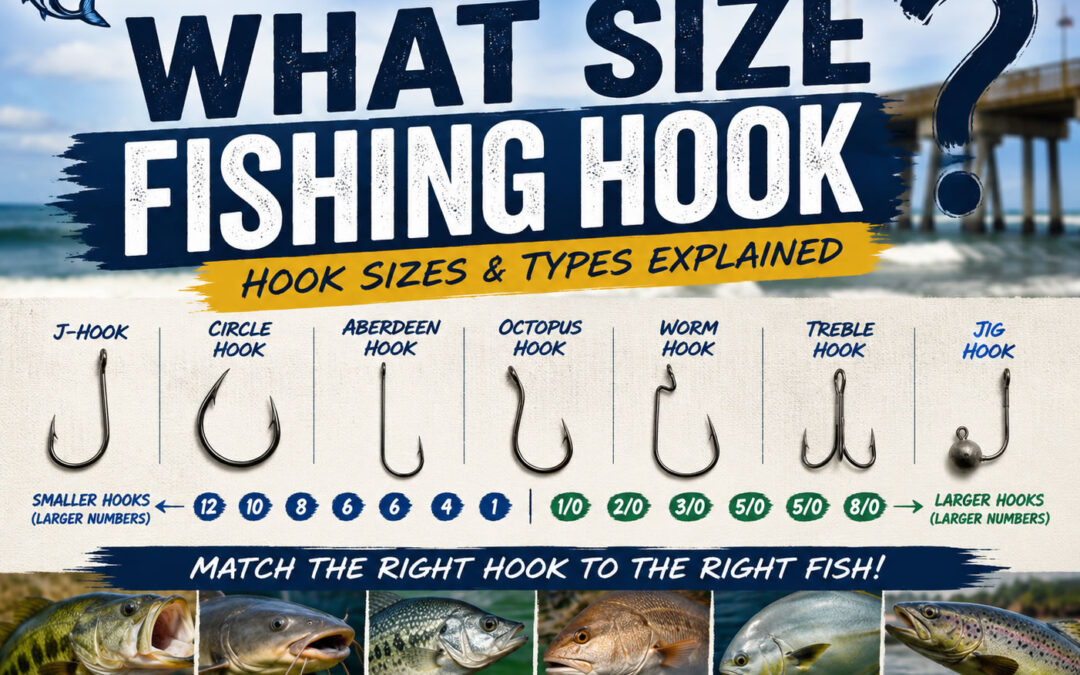
Fishing hook sizes can be confusing because the numbering system goes in two directions.
For regular numbered hooks, the larger the number, the smaller the hook.
That means:
- Size 12 is smaller than size 8
- Size 8 is smaller than size 4
- Size 4 is smaller than size 1
After size 1, hooks move into “aught” sizes, written as 1/0, 2/0, 3/0, and so on. With aught hooks, the larger the number, the larger the hook.
That means:
- 1/0 is smaller than 3/0
- 3/0 is smaller than 5/0
- 5/0 is smaller than 8/0
Small panfish may need a size 8 or 10 hook. A largemouth bass may need a 3/0 worm hook. A large catfish may need a 6/0 or 8/0 circle hook.
Small Hooks vs Large Hooks
A common beginner mistake is using a hook that is too large. Big hooks can look strong, but they may stop smaller fish from getting the bait in their mouth. If fish keep nibbling your bait without getting hooked, your hook may be too large.
Small hooks can catch surprisingly big fish, but they may bend, break, or get swallowed if they are not matched to the fish and tackle.
A good hook should:
- Fit the bait naturally
- Fit inside the fish’s mouth
- Be strong enough for the fish
- Leave enough hook point exposed
- Match the line, rod, and drag setting
The goal is not to use the biggest hook possible. The goal is to use the right hook for the bait and fish.
Best Hook Size for Crappie
Crappie have larger mouths than bluegill, but they also have thin, delicate mouths. You do not need a heavy hook for most crappie fishing.
Good hook sizes:
- Size 2
- Size 4
- Size 6
Best hook types:
- Aberdeen hooks
- Light-wire hooks
- Jig hooks
- Minnow hooks
Good baits and lures:
- Live minnows
- Small jigs
- Crappie tubes
- Soft plastics
- Hair jigs
Aberdeen hooks are popular for crappie because they are thin and work well with minnows. They can also bend free from light snags, which helps when fishing around brush and timber.
Best Hook Size for Catfish
Catfish hooks depend on the size of the fish and the bait.
Good hook sizes:
- 1/0 to 3/0 for small channel catfish
- 3/0 to 5/0 for medium catfish
- 6/0 to 8/0 or larger for big blue catfish and flathead catfish
Best hook types:
- Circle hooks
- Kahle hooks
- Octopus hooks
- Bait hooks
Good baits:
- Cut bait
- Chicken liver
- Shrimp
- Nightcrawlers
- Prepared stink bait
- Live bait for flatheads where legal
Circle hooks are a strong choice for catfish, especially if you plan to release fish. They often hook the fish in the corner of the mouth. With circle hooks, do not jerk hard to set the hook. Let the rod load up and reel steadily.
Best Hook Size for Red Drum
Red drum can be caught on a wide range of hooks depending on whether you are fishing bait, lures, or surf rigs.
Good hook sizes:
- 1/0 to 3/0 for smaller drum and inshore bait fishing
- 3/0 to 5/0 for slot-sized red drum
- 6/0 to 8/0 circle hooks for larger surf baits and bigger drum
Best hook types:
- Circle hooks
- Jig hooks
- Octopus hooks
- Live bait hooks
Good baits and lures:
- Shrimp
- Cut mullet
- Menhaden
- Finger mullet
- Mud minnows
- Soft plastics
- Spoons
- Popping cork rigs
For bait fishing, circle hooks are commonly used because they help reduce deep hooking. Match the hook to the bait size. A small shrimp does not need a giant hook, but a large chunk of cut bait in the surf may require a much larger circle hook.
Common Types of Fishing Hooks
Different hooks are designed for different baits, lures, and fish. Here are the most common types beginners should know.
J-Hooks
J-hooks are the classic fishing hook shape. They work well for many types of bait fishing, but anglers usually need to set the hook.
Best for:
- Worms
- Minnows
- Shrimp
- General bait fishing
- Panfish
- Bass
- Trout
J-hooks are simple and versatile, but they may deep-hook fish if you wait too long to set the hook.
Circle Hooks
Circle hooks are designed to slide toward the corner of the fish’s mouth as the fish moves away. They are popular for catfish, drum, surf fishing, and catch-and-release fishing.
Best for:
- Catfish
- Red drum
- Black drum
- Sharks
- Surf fishing
- Cut bait
- Live bait
With circle hooks, do not jerk hard. Let the fish pull, then reel steadily.
Aberdeen Hooks
Aberdeen hooks are thin, light-wire hooks with a long shank. They are popular for crappie, bluegill, and live minnows.
Best for:
- Crappie
- Bluegill
- Sunfish
- Minnows
- Worms
- Light tackle
They are also useful around brush because they may bend free from snags.
Octopus Hooks
Octopus hooks are short-shank hooks with a wide gap and slightly turned eye. They are useful for bait fishing and can work well with smaller live baits.
Best for:
- Trout
- Walleye
- Catfish
- Red drum
- Live bait
- Cut bait
They are compact and strong for their size.
Kahle Hooks
Kahle hooks have a wide gap and are often used with live bait or larger natural baits. They can work well for catfish, drum, and other bait-eating fish.
Best for:
- Catfish
- Drum
- Live bait
- Cut bait
- Larger natural baits
Kahle hooks can hook fish deeply if anglers wait too long, so pay attention to bites.
Treble Hooks
Treble hooks have three points and are common on crankbaits, jerkbaits, spoons, topwater lures, and some prepared bait rigs.
Best for:
- Hard lures
- Crankbaits
- Topwater plugs
- Spoons
- Some trout baits
- Some catfish dip bait rigs
Treble hooks can be harder to remove and are not always ideal for catch-and-release fishing.
Worm Hooks
Worm hooks are designed for soft plastic bass baits. They are often used for Texas rigs, Carolina rigs, creature baits, worms, and flukes.
Best for:
- Bass
- Soft plastic worms
- Creature baits
- Flukes
- Texas rigs
- Carolina rigs
Common sizes are 2/0, 3/0, 4/0, and 5/0.
Jig Hooks and Jig Heads
Jig hooks are built into weighted jig heads. They are used with soft plastics, hair jigs, live bait, and many freshwater or saltwater lures.
Best for:
- Crappie
- Bass
- Trout
- Flounder
- Speckled trout
- Red drum
- White perch
- Saltwater soft plastics
Jig head weight matters as much as hook size. Use enough weight to reach the fish without making the lure look unnatural.
Best Hook Size for Bluegill and Sunfish
For bluegill, sunfish, shellcracker, and other small panfish, use small hooks.
Good hook sizes:
- Size 8
- Size 10
- Size 12
Best hook types:
- Aberdeen hooks
- Bait hooks
- Small long-shank hooks
- Small jig hooks
Good baits:
- Worms
- Crickets
- Small pieces of nightcrawler
- Bread
- Small grubs
- Tiny jigs
Bluegill have small mouths, so smaller hooks usually work better. A size 8 hook is a good all-around choice. If the fish are small or stealing bait, drop to size 10 or 12.
Best Hook Size for Bass
Bass hook size depends heavily on the lure or bait.
Good hook sizes:
- 1/0 to 5/0 for soft plastics
- Size 1 to 2/0 for live bait
- 3/0 or 4/0 for many Texas-rigged worms
- 4/0 or 5/0 for larger creature baits, flukes, and swimbaits
Best hook types:
- Offset worm hooks
- Extra wide gap hooks
- Straight shank hooks
- Drop shot hooks
- Wacky rig hooks
- Treble hooks on hard baits
- Jig hooks
For live bait such as minnows, shiners, or nightcrawlers, a size 1 to 2/0 hook can work well. For soft plastics, match the hook to the body size of the bait. A small finesse worm may only need a 1/0 or 2/0 hook, while a larger worm or creature bait may need a 4/0 or 5/0 hook.
Best Hook Size for Trout
Trout usually require smaller hooks, especially in clear water or pressured areas.
Good hook sizes:
- Size 8
- Size 10
- Size 12
- Size 14 for very small baits or flies
Best hook types:
- Bait hooks
- Salmon egg hooks
- Small treble hooks for some prepared baits
- Fly hooks
- Jig hooks
Good baits and lures:
- Worms
- Salmon eggs
- Corn where legal
- Prepared trout bait
- Small spinners
- Small jigs
- Flies
For catch-and-release trout fishing, single barbless hooks are often easier on the fish and easier to remove.
Best Hook Size for Pompano and Surf Fishing
Surf fishing hook size depends on the species.
For pompano, sea mullet, spot, and croaker:
- Size 1
- Size 2
- Size 4
For red drum, black drum, bluefish, sharks, and larger surf species:
- 2/0 to 8/0 depending on bait and fish size
Best hook types:
- Circle hooks
- Kahle hooks
- Surf hooks
- Bait hooks
- Pompano rig hooks
Good surf baits:
- Sand fleas
- Shrimp
- Fishbites
- Squid
- Cut mullet
- Cut bait
- Finger mullet
For pompano rigs, smaller hooks are usually better. Pompano have small mouths compared with big drum or sharks, so oversized hooks can reduce bites.
Hook Size Chart by Fish
Use this as a simple starting point:
| Fish | Hook Sizes | Good Hook Types |
|---|---|---|
| Bluegill / Sunfish | 8, 10, 12 | Aberdeen, bait hook |
| Crappie | 2, 4, 6 | Aberdeen, jig hook |
| Trout | 8, 10, 12, 14 | Bait hook, egg hook, fly hook |
| Bass | 1/0 to 5/0 | Worm hook, EWG, drop shot, treble |
| Channel Catfish | 1/0 to 5/0 | Circle, kahle, octopus |
| Blue Catfish | 5/0 to 10/0 | Circle, kahle |
| Flathead Catfish | 5/0 to 10/0 | Circle, live bait hook |
| Pompano | 1, 2, 4 | Circle, bait hook |
| Sea Mullet / Spot / Croaker | 2, 4, 6 | Bait hook, circle hook |
| Red Drum | 1/0 to 8/0 | Circle, jig hook |
| Black Drum | 1/0 to 8/0 | Circle, bait hook |
| Speckled Trout | 1/0 to 3/0 | Jig hook, treble on lures |
| Flounder | 1/0 to 5/0 | Kahle, jig hook, live bait hook |
| Sharks | 6/0 and larger | Circle hook |
Common Beginner Mistakes
The most common hook mistake is using a hook that is too big. If you are getting bites but not hooking fish, try a smaller hook.
Another mistake is burying the hook point in bait. The hook point needs to be exposed enough to catch the fish.
Beginners also sometimes use the wrong hook type. A circle hook should not be set like a bass hook. A treble hook may not be the best choice for catch-and-release. A heavy hook may be too much for small bait.
Finally, rusty or dull hooks cost fish. Replace old hooks or sharpen them when needed.
Did You Fish? Choosing the Right Fishing Hook
Choosing the right fishing hook gets easier once you think about the fish, the bait, and the way the fish feeds. Small fish with small mouths need smaller hooks. Bigger fish, larger bait, stronger current, heavier tackle, and surf fishing may require larger hooks. Live bait often works best on hooks that let the bait move naturally. Cut bait often works well on circle hooks or kahle hooks. Soft plastics usually need worm hooks, jig hooks, extra wide gap hooks, or other specialty bass fishing hooks.
For beginner anglers, it is smart to carry a small hook selection instead of buying every hook on the wall. A simple tackle box might include size 8 and 10 hooks for bluegill and sunfish, size 2 and 4 Aberdeen hooks for crappie, 3/0 and 4/0 worm hooks for bass, 3/0 to 6/0 circle hooks for catfish and drum, and a few small surf hooks for pompano, sea mullet, spot, and croaker. That small selection can cover a lot of freshwater and saltwater fishing without making your tackle box confusing.
The best hook is not always the biggest or most expensive. It is the fishing hook that matches your bait, fits the fish’s mouth, stays sharp, and gives you a clean hookup. If fish are stealing bait, downsize your hook. If hooks are bending, go heavier. If fish are swallowing the hook, switch to a circle hook or set the hook sooner. If your bait looks stiff or unnatural, try a smaller, lighter, or thinner hook so the bait moves more naturally in the water.
Hook size also affects how confidently fish bite. A bluegill may peck at a worm on a large hook but easily take the same bait on a size 8 or size 10 hook. Crappie often respond better to light-wire hooks and small jigs that match minnows and tiny baitfish. Bass anglers may need a larger hook for a thick soft plastic worm, creature bait, or swimbait, but a smaller hook for finesse fishing, drop shot rigs, or wacky rigs. Catfish anglers often do better when the hook size matches the bait size, especially when using cut bait, chicken liver, shrimp, or live bait. Surf anglers should also think carefully about hook size because pompano, sea mullet, spot, and croaker usually need smaller hooks than red drum, black drum, sharks, or large bluefish.
Whether you are fishing for bluegill in a pond, crappie around brush, bass with soft plastics, catfish from the bank, trout in a stream, red drum inshore, pompano in the surf, or sharks from the beach, hook size matters. Start simple, pay attention to what the fish are doing, and adjust from there. The more you fish, the easier it becomes to know when to go smaller, when to go stronger, and when to switch hook types completely. A good fishing hook should help the bait look right, help the fish take the bait naturally, and give you the best chance of landing the fish once it bites.