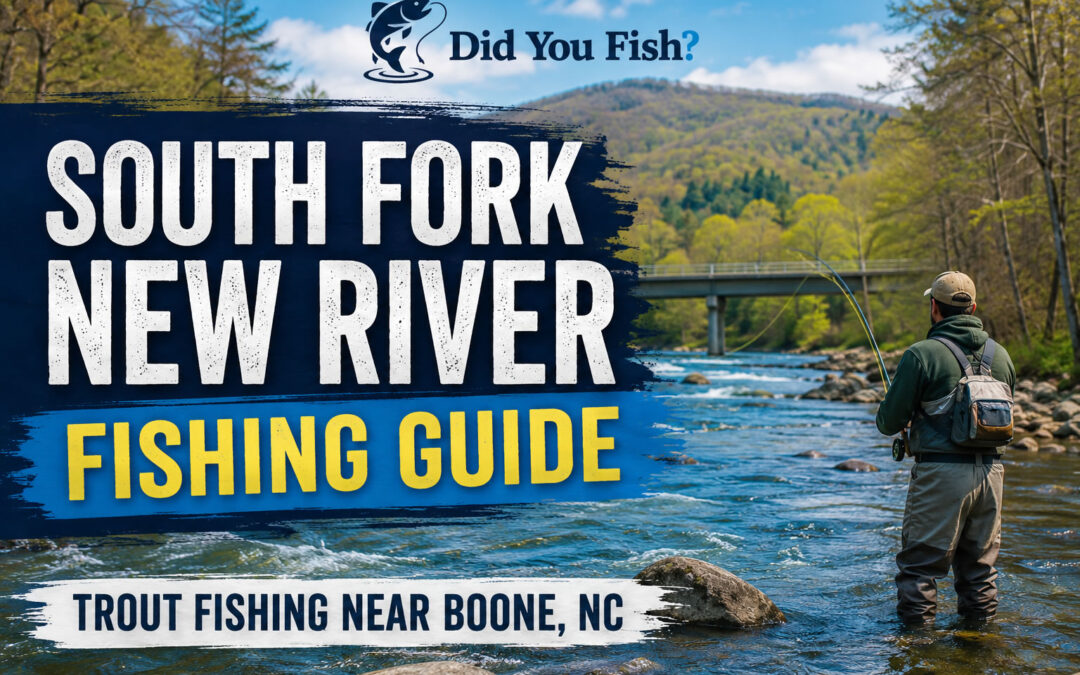
South Fork New River Trout Fishing Guide
The South Fork New River is one of the most accessible fishing waters in the Boone and High Country area of North Carolina. If you are looking for trout fishing near Boone, Brookshire Park, Todd, or Watauga County, the South Fork New River is a good place to begin researching.
South Fork New River fishing can vary considerably depending on the section. Near Boone, anglers can find managed trout water, public greenway access, pools, shallow runs, current seams, and slower water around bends. Farther downstream toward Todd, the river becomes wider and includes a section managed under Delayed Harvest Trout Water regulations.
The most important thing to understand is that the entire South Fork New River is not managed under one set of rules. The Boone section near Brookshire Park is classified differently from the Delayed Harvest section in Todd. Bait, lure, hook, and harvest regulations may change depending on the location and time of year, so anglers should check the official North Carolina trout waters information before fishing.
Quick Answer: Is the South Fork New River Good for Trout Fishing?
Yes, the South Fork New River can be a good trout fishing destination near Boone and Todd, North Carolina. Anglers fish the South Fork for rainbow trout, brown trout, and brook trout in designated managed sections, while smallmouth bass and other warmwater species become more common farther downstream.
The river is especially useful for anglers looking for accessible fishing near Boone. The section around Brookshire Park is managed as Hatchery Supported Trout Water, while a section in Todd is managed as Delayed Harvest Trout Water. Because the regulations change by location and season, anglers should always confirm the exact section before fishing.
Where Is the South Fork New River?
The South Fork New River flows through the Boone area of western North Carolina before continuing north toward Todd and eventually becoming part of the larger New River system.
For trout anglers, two of the most commonly discussed areas are the public water near Boone and the managed trout section in Todd. The Boone Greenway and Brookshire Park provide recognizable access around the upper river, while Todd offers a different type of fishing in broader water.
Do not search for the South Fork New River and assume every visible section is open to the public. The river passes through a mixture of public and private land. Select a specific access area, confirm where parking is permitted, and check the regulations for that exact section before fishing.
South Fork New River Delayed Harvest Water in Todd
The South Fork New River also includes a designated Delayed Harvest Trout Water section in Todd.
Delayed Harvest waters are stocked and managed under special seasonal regulations. During the catch-and-release portion of the season, trout may not be harvested, natural bait may not be possessed, and anglers may be limited to artificial lures with one single hook.
This makes Todd different from the Hatchery Supported water near Boone. A bait that may be legal at one location may be prohibited in another section of the same river.
The Todd water is generally wider and more open than the upper river around Boone. Anglers may find longer runs, shallow riffles, deeper bends, current breaks, and broad glides.
Always check current regulations because dates and restrictions can change.
Best Time of Day for South Fork New River Trout
The best time of day depends on water temperature, weather, season, and fishing pressure.
Good fishing windows may include:
- Early morning during warm weather
- Late afternoon and evening
- Cloudy days
- Periods of insect activity
- After light rain when the river has some color
- The warmest portion of a winter day
- Times when water temperatures are cool and stable
Popular public areas may become busy during weekends. Early morning can provide less fishing pressure and fewer walkers, paddlers, and other river users.
Spin Fishing the South Fork New River
You do not need to fly fish to catch trout in the South Fork New River.
A simple spinning setup might include:
- 5- to 7-foot ultralight or light rod
- 1000- to 2500-size spinning reel
- 4- to 6-pound line
- Small inline spinners
- Small spoons
- Trout jigs
- Small hooks
- Split shot
- Small floats
- Legal bait where permitted
Cast upstream or slightly across the current and allow the lure to move through the strike zone naturally. In clear water, smaller lures and lighter line often work better.
Common Mistakes on the South Fork New River
One of the biggest mistakes is assuming that the Boone and Todd sections have the same regulations. They do not.
Another common mistake is carrying natural bait into Delayed Harvest water during a period when bait possession is prohibited.
Anglers also frequently use tackle that is too heavy. Thick line, oversized hooks, and excessive weight can make a presentation look unnatural in clear mountain water.
Do not fish only the most obvious pool beside the parking area. Easily reached water often receives the most pressure. A short walk may lead to quieter runs and less cautious trout.
Brookshire Park and Boone Greenway Fishing
Brookshire Park and the Boone Greenway are among the most recognizable areas associated with South Fork New River fishing near Boone.
These areas can be convenient for visiting anglers because they are easier to find than isolated mountain access points. They may also be more suitable for beginners who are not comfortable exploring remote streams.
Easy access also means increased fishing pressure. Trout near trails, bridges, and parking areas may see many anglers. Use lighter line, approach quietly, and look for less obvious current seams, shaded edges, and small pockets.
Remember that the Greenway is shared with walkers, cyclists, families, and dogs. Keep hooks, loose line, and tackle away from the trail.
South Fork New River Trout Fishing Near Boone
The South Fork New River near Boone includes a designated Hatchery Supported Trout Water section associated with the area around Brookshire Park.
This portion of the river can appeal to beginners because it is easier to locate than many remote mountain streams. The Boone Greenway follows parts of the river and provides nearby walking paths, recreation areas, and public access points.
Anglers may encounter:
- Shallow riffles
- Small pools
- Current seams
- Undercut banks
- Bridge structure
- Gravel runs
- Slow water along bends
- Deeper pockets near cover
The river can become clear during stable weather. Light line, small lures, and quiet approaches usually work better than heavy tackle.
Public Access and Private Property
Public access is one of the most important parts of fishing the South Fork New River.
Some sections around Brookshire Park, the Boone Greenway, and designated areas in Todd are easier to identify as public. Other stretches may run beside roads but still be surrounded by private land.
Before fishing, confirm:
- Where you can legally park
- Whether the riverbank is public
- Whether wading access is permitted
- Whether the section is Hatchery
- Supported or Delayed Harvest
- Whether natural bait is allowed
- Whether single hooks are required
- Whether trout may be harvested
Never cross a yard, field, fence, or posted property without permission.
Best Bait and Lures for the South Fork New River
The best bait or lure depends on the exact section and regulations.
Where natural bait is legal, anglers may try:
- Small worms
- Salmon eggs
- Trout dough bait
- Waxworms
- Small pieces of nightcrawler
- Corn where permitted
Artificial options include:
- Small inline spinners
- Small spoons
- Trout jigs
- Soft-plastic trout worms
- Small minnow lures
- Nymphs
- Woolly buggers
- Small streamers
- Dry flies
During Delayed Harvest catch-and-release season, natural bait may not be possessed. Check whether one single hook is required before using a lure.r.
South Fork New River Trout Species
Managed sections of the South Fork New River may provide opportunities for:
Rainbow trout
Brown trout
Brook trout
Rainbow trout are common in stocked waters and are often willing to strike small spinners, bait, nymphs, and trout jigs.
Brown trout may hold near deeper pools, undercut banks, rocks, roots, and shaded cover.
Brook trout are associated with colder mountain water and may also be stocked in managed sections.
Farther downstream, anglers may also encounter:
Smallmouth bass
Rock bass
Sunfish
Not every section contains the same fish population.
South Fork New River Trout Species
If you enjoyed this South Fork New River fishing guide, you may also find these related North Carolina trout fishing resources helpful. Our Watauga River Trout Fishing Guide covers another popular High Country river near Boone, including access, trout species, seasonal conditions, and practical fishing tips. You can also read our guide to the Best Trout Baits for North Carolina Mountain Streams for ideas on productive natural baits, lures, and presentations. For a broader look at fishing throughout the area, visit our Boone Trout Fishing Guide, which highlights additional streams, public access areas, and trout-fishing opportunities around Boone and the surrounding mountains.
Did You Fish? South Fork New River Trout Fishing
The South Fork New River is one of the more versatile fishing waters near Boone, Brookshire Park, and Todd, North Carolina. It gives anglers access to stocked trout water, Delayed Harvest fishing, public recreation areas, mountain scenery, and warmer downstream sections that may hold smallmouth bass and other species.
For beginners, the best approach is to select one known public area and learn the regulations for that exact section. The Hatchery Supported water near Boone does not necessarily follow the same bait and harvest rules as the Delayed Harvest section in Todd. Check the current North Carolina trout waters map, read posted signs, and do not assume that a lure or bait legal in one location is permitted everywhere.
A light spinning rod, 4- to 6-pound line, small inline spinners, spoons, trout jigs, and legal bait can be enough to get started. Fly anglers can carry a basic selection of nymphs, woolly buggers, small streamers, and dry flies. In clear water, smaller presentations and natural drifts usually work better than heavy equipment.
Pay attention to the current. Trout frequently hold where fast water meets slower water, behind rocks, below riffles, around undercut banks, and at the head or tail of a pool. Cast above these areas and allow the presentation to move naturally toward the fish. If you are not getting bites, change your depth, reduce the amount of weight, use a smaller lure, or move to another run.
Fishing conditions can change quickly in the North Carolina High Country. Rain can raise and discolor the river, summer heat can stress trout, and winter cold can slow feeding. Spring and fall often provide favorable trout conditions, but the best day depends on water temperature, river level, stocking activity, and fishing pressure.
Access also matters. Stay within established public areas, park legally, and never cross private property without permission. The South Fork passes through both public and private land, and being able to see the river from a road does not mean the bank is open to anglers.
The river is shared by fishermen, paddlers, walkers, families, and nearby residents. Give other anglers room, reel in when paddlers pass, pick up discarded line, and avoid posting private access locations online.
The South Fork New River does not need to be treated as a secret fishing spot. It should be treated as a public resource that deserves accurate information, responsible fishing, and respect for the surrounding community.
Have you fished the South Fork New River lately? Share the general area, what you caught, the water conditions, and which bait, flies, or lures were working.