What Size Sinker Should You Use for Fishing? Beginner Weight Guide
Choosing the right fishing sinker can make a big difference, especially when you are just getting started. A sinker may look like a simple piece of lead or metal, but the size and shape of the weight can affect casting distance, bait movement, depth, bottom contact, and how naturally your bait looks to fish.
Use too little weight and your bait may drift away, float too high, or never reach the fish. Use too much weight and your bait may look unnatural, bury in the bottom, or make it harder to feel bites. The right sinker depends on where you are fishing, what bait you are using, how much current or surf is present, and what fish you are targeting.
The good news is that beginners do not need every fishing weight in the tackle aisle. A small selection of split shot, egg sinkers, bullet weights, bank sinkers, and pyramid sinkers can cover most freshwater and saltwater fishing situations.
Quick Answer: What Size Sinker Should You Use?
For small pond and lake fishing, use the lightest sinker that gets your bait where it needs to go. Small split shot or 1/16- to 1/4-ounce sinkers are often enough for bluegill, trout, crappie, and light bait fishing.
For bass fishing, bullet weights from 1/8 to 1/2 ounce are common for Texas rigs, while heavier weights may be used in thick grass, deeper water, or heavy cover.
For catfish, many anglers use 1/2-ounce to 3-ounce sinkers depending on current, casting distance, and bait size.
For surf fishing, 2- to 5-ounce pyramid sinkers are common, with heavier weights needed when the surf, wind, or current is strong.
The simple rule is this: use enough weight to hold or present your bait correctly, but not so much that it kills the natural movement of the bait.
Why Sinker Size Matters
Sinker size matters because it controls where your bait sits and how it behaves in the water. Fish often feed at specific depths, around structure, near the bottom, or in moving water. Your sinker helps put the bait in that zone.
A good sinker setup can help you:
- Cast farther
- Keep bait near the bottom
- Hold bait in current
- Keep bait in the strike zone
- Help a bobber sit correctly
- Let live bait move naturally
- Detect bites more easily
- Fish different depths and conditions
A bad sinker setup can do the opposite. Too much weight can make small bait look stiff. Too little weight can keep bait from reaching the fish. The wrong sinker shape can roll in current, drag in the surf, or snag too easily.
Best Sinker Size for Bluegill and Sunfish
For bluegill, sunfish, and other small panfish, keep the weight light.
Good sinker sizes:
- Small split shot
- 1/32 ounce
- 1/16 ounce
- 1/8 ounce if fishing deeper water
Best rigs:
- Bobber rig
- Small hook and split shot
- Tiny jig
- Light bottom rig
Bluegill often feed in shallow water, around docks, grass, brush, and shoreline cover. A small split shot is usually enough to help a worm, cricket, or small bait sink naturally.
Too much weight can make the bait drop too fast or look unnatural.
Best Sinker Size for Crappie
Crappie fishing often uses light tackle. The weight depends on whether you are fishing minnows, jigs, or deeper structure.
Good sinker sizes:
- Small split shot
- 1/16 ounce
- 1/8 ounce
- 1/4 ounce for deeper water or wind
Best rigs:
- Minnow rig
- Slip bobber rig
- Jig
- Double jig rig
- Light dropper rig
For crappie with minnows, a small split shot or light sinker is often enough. For jigs, the jig head itself provides the weight. Common crappie jig sizes include 1/32, 1/16, and 1/8 ounce.
Use lighter jigs when fish are shallow or slow. Use heavier jigs when fish are deeper, wind is strong, or you need to stay vertical.
Best Sinker Size for Bass
Bass fishing weights depend on the lure, depth, cover, and technique.
Good sinker sizes:
- 1/8 ounce for shallow finesse fishing
- 3/16 ounce for light Texas rigs
- 1/4 ounce for all-around soft plastics
- 3/8 ounce for deeper water or moderate cover
- 1/2 ounce or more for heavy cover, grass, or flipping
Best rigs:
- Texas rig
- Carolina rig
- Wacky rig with nail weight
- Drop shot rig
- Shaky head
- Jig head
A 1/4-ounce bullet weight is a good starting point for many beginner bass anglers. It casts well, sinks at a reasonable speed, and works with many soft plastic worms and creature baits.
If bass are shallow and pressured, go lighter. If you are fishing deeper, windy conditions, or thick cover, go heavier.
Best Sinker Size for Catfish
Catfish sinker size depends on current, depth, casting distance, and bait size.
Good sinker sizes:
- 1/2 ounce for ponds and calm water
- 1 ounce for lakes and light current
- 2 ounces for deeper water or moderate current
- 3 ounces or more for strong current, large bait, or long casts
Best rigs:
- Slip sinker rig
- Carolina rig
- Santee rig
- Three-way rig
- High-low rig
- No-roll sinker rig
For small channel catfish in ponds, a 1/2-ounce egg sinker may be enough. For bigger catfish in reservoirs or rivers, 2- to 4-ounce no-roll sinkers or bank sinkers may be better.
If your bait keeps moving away from where you cast, increase weight or switch to a no-roll sinker.
Best Sinker Size for Trout
Trout often require light weight and natural presentation.
Good sinker sizes:
- Tiny split shot
- Small split shot
- 1/32 ounce
- 1/16 ounce
- 1/8 ounce in deeper pools or stronger current
Best rigs:
- Split shot rig
- Drift rig
- Float rig
- Small jig
- Carolina-style bait rig
In clear water, trout can be line- and presentation-sensitive. Use just enough weight to get bait down without dragging it unnaturally. In moving water, add or remove split shot until the bait drifts naturally near the bottom.
Best Sinker Size for Surf Fishing
Surf fishing usually requires more weight than pond or lake fishing because waves, current, and wind move your rig.
Good sinker sizes:
- 2 ounces for calm surf
- 3 ounces for average surf
- 4 ounces for rougher surf
- 5 ounces or more for strong current, wind, or heavy bait
Best rigs:
- Pompano rig
- Two-hook bottom rig
- Fish finder rig
- High-low rig
- Cut bait rig
Best sinkers:
- Pyramid sinkers
- Sputnik sinkers
- Storm sinkers
- Bank sinkers in calmer water
For surf fishing in North Carolina, a 3-ounce pyramid sinker is a useful starting point. If the rig washes down the beach, go heavier. If conditions are calm and fish are close, you may be able to go lighter.
Best Sinker Size for Pier Fishing
Pier fishing sinker size depends on depth, current, wind, and target species.
Good sinker sizes:
- 1 ounce for light bottom fishing
- 2 ounces for deeper water or moderate current
- 3 ounces or more for stronger current or heavier bait
- Small split shot or light weights for small bait near pilings
Best rigs:
- Bottom rig
- High-low rig
- Fish finder rig
- Carolina rig
- Dropper rig
- Sabiki rig for bait
For sea mullet, spot, croaker, and pompano, a 1- to 2-ounce sinker may be enough from a pier. For drum, sharks, rays, or heavier current, you may need more.
Around pilings, be careful with too much weight. Heavy sinkers can snag quickly if the rig gets pulled into structure.
Best Sinker Size for Inshore Saltwater Fishing
Inshore saltwater fishing often uses lighter weights than surf fishing but heavier weights than small pond fishing.
Good sinker sizes:
- 1/8 ounce for shallow soft plastics
- 1/4 ounce for all-around inshore jigheads
- 3/8 ounce for deeper current or windy conditions
- 1/2 ounce or more for strong current, deep channels, or heavier bait
Best rigs:
- Jig head and soft plastic
- Carolina rig
- Popping cork rig
- Fish finder rig
- Live bait rig
For red drum, speckled trout, flounder, and black drum, the goal is usually to keep the bait or lure near the strike zone without making it look unnatural. Around docks, creeks, marsh drains, oyster edges, and inlets, current can change quickly, so adjust weight as needed.
Use the Lightest Weight That Works
One of the best beginner rules is to use the lightest sinker that still does the job.
If you are fishing a pond with a worm under a bobber, you may only need one tiny split shot. If you are fishing a lake bottom rig for catfish, you may need a 1-ounce egg sinker. If you are surf fishing in strong waves, you may need a 4-ounce pyramid sinker to hold bottom.
The right weight changes with conditions. A calm day may call for less weight. Wind, current, deeper water, larger bait, or rough surf may require more.
Do not choose sinker size only by the fish. Choose sinker size by the fishing situation.
Common Types of Fishing Sinkers
Different sinker shapes are made for different jobs. Here are the most common types beginner anglers should understand.
Split Shot Sinkers
Split shot sinkers are small round weights that pinch onto the fishing line. They are one of the easiest weights for beginners to use.
Best for:
- Bluegill
- Sunfish
- Trout
- Small pond fishing
- Bobber rigs
- Worm fishing
- Light bait fishing
Common sizes:
- Tiny split shot for small hooks and light bait
- Medium split shot for deeper water or light current
- Multiple split shot when you need a little more weight
Split shot are great when you want to add just enough weight to help bait sink. They are commonly used with worms, crickets, salmon eggs, small minnows, and other light baits.
For bluegill or sunfish, place a small split shot 6 to 12 inches above the hook. For trout, you may need to adjust the distance depending on current and depth.
Egg Sinkers
Egg sinkers are oval-shaped weights with a hole through the middle. The fishing line passes through the sinker, which allows the bait to move more freely.
Best for:
- Catfish
- Carolina rigs
- Bottom fishing
- Live bait
- Cut bait
- Lakes and rivers
Common sizes:
- 1/4 ounce
- 1/2 ounce
- 1 ounce
- 2 ounces
- 3 ounces or more for stronger current
Egg sinkers are popular for catfish rigs because fish can pick up the bait without immediately feeling the full weight. They also work well for Carolina rigs used for bass, trout, red drum, and other species.
If you are fishing from the bank for catfish in a pond or lake, a 1/2-ounce or 1-ounce egg sinker is often a good starting point. In current, you may need more.
Pyramid Sinkers
Pyramid sinkers are shaped like a pyramid and are made to dig into sand. They are one of the most common surf fishing weights.
Best for:
- Surf fishing
- Pier fishing
- Beach fishing
- Pompano rigs
- Bottom fishing in sand
- Red drum
- Sea mullet
- Pompano
- Spot
- Croaker
- Sharks
Common sizes:
- 2 ounces for calm surf
- 3 ounces for moderate surf
- 4 ounces for stronger surf
- 5 ounces or more for rough surf or heavy current
Pyramid sinkers are useful because they hold bottom better than round sinkers in sand. If your rig keeps washing down the beach, go heavier or switch to a better holding sinker.
For many North Carolina surf fishing situations, a 3-ounce pyramid sinker is a good all-around starting point.
Bank Sinkers
Bank sinkers are rounded, teardrop-style sinkers with an eye at the top. They are commonly used for bottom fishing.
Best for:
- Catfish
- Pier fishing
- Bridge fishing
- Bottom rigs
- Deeper water
- River fishing
- Saltwater bottom fishing
Common sizes:
- 1/2 ounce
- 1 ounce
- 2 ounces
- 3 ounces
- 4 ounces or more for deeper water or current
Bank sinkers cast well and are simple to use. They can roll more than pyramid sinkers in surf, but they work well for many bottom fishing situations in lakes, rivers, piers, bridges, and deeper water.
No-Roll Sinkers
No-roll sinkers are flat sinkers designed to stay in place better than round weights. They are popular with catfish anglers, especially in rivers.
Best for:
- Catfish
- River fishing
- Current
- Bottom rigs
- Cut bait
- Bank fishing
Common sizes:
- 1 ounce
- 2 ounces
- 3 ounces
- 4 ounces or more for strong current
A no-roll sinker is useful when an egg sinker rolls too much. The flat shape helps keep the bait where you cast it.
For catfish in rivers or current, no-roll sinkers can be a better choice than egg sinkers.
Bullet Weights
Bullet weights are cone-shaped sinkers used mostly with soft plastics, especially for bass fishing.
Best for:
- Bass
- Texas rigs
- Carolina rigs
- Worms
- Creature baits
- Craws
- Fishing grass or cover
Common sizes:
- 1/8 ounce
- 3/16 ounce
- 1/4 ounce
- 3/8 ounce
- 1/2 ounce
- 3/4 ounce or more for heavy cover
A 1/4-ounce bullet weight is a good starting point for many Texas-rigged worms. Go lighter in shallow water or when fish want a slower fall. Go heavier in deep water, wind, thick grass, or heavy cover.
Drop Shot Weights
Drop shot weights are used below the hook on a drop shot rig. They let the bait hover above the bottom.
Best for:
- Bass
- Panfish
- Perch
- Finesse fishing
- Clear water
- Deeper structure
Common sizes:
- 1/8 ounce
- 3/16 ounce
- 1/4 ounce
- 3/8 ounce
Drop shot weights are not usually the first sinker beginners buy, but they are useful if you fish soft plastics for bass in clear water or around deeper structure.
Common Beginner Mistakes with Sinkers
The most common mistake is using too much weight. Beginners often think heavier is better because it casts farther. But heavy sinkers can make bait look unnatural, bury small bait in the bottom, and make subtle bites harder to detect.
Another mistake is using too little weight. If your bait never reaches the fish, drifts too fast, or washes away in the surf, you need more weight or a different sinker shape.
Some anglers also use the wrong sinker type. A round sinker may roll too much in current. A pyramid sinker may hold better in sand. A split shot is good for a bobber rig but not ideal for heavy catfish bait. A bullet weight works well for bass soft plastics but is not the best surf fishing sinker.
Another mistake is ignoring the bait size. Small bait needs small weight. Big bait may need more weight to cast and stay in place.
Sinker Size Chart by Fishing Situation
Use this as a simple starting point:
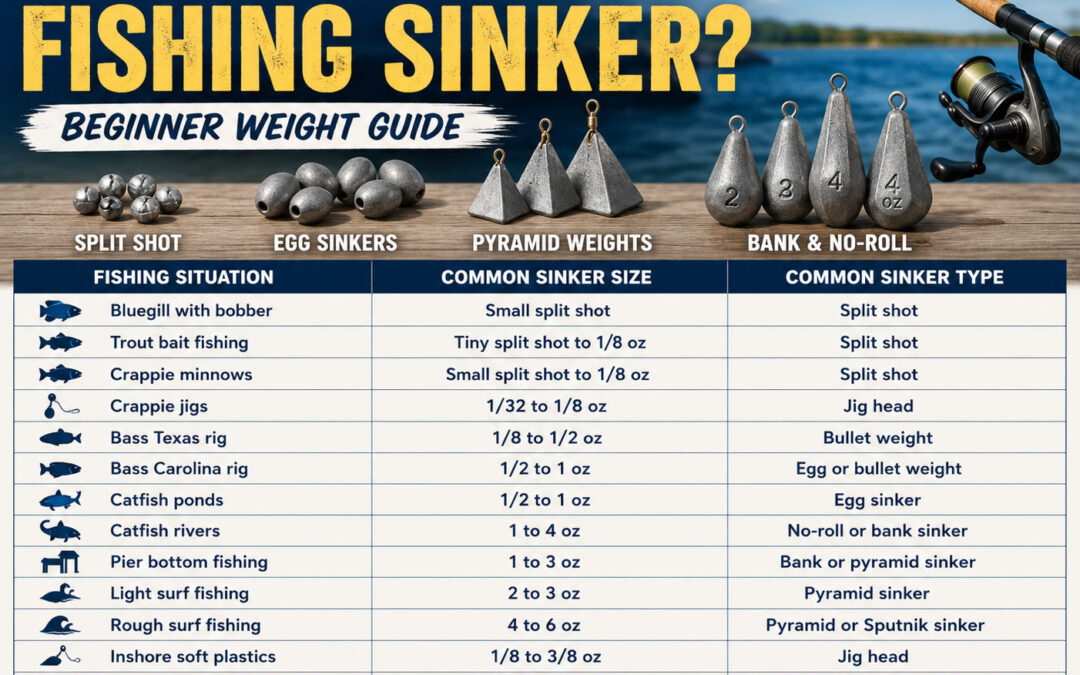
| Fishing Situation | Common Sinker Size | Common Sinker Type |
|---|---|---|
| Bluegill with bobber | Small split shot | Split shot |
| Trout bait fishing | Tiny split shot to 1/8 oz | Split shot |
| Crappie minnows | Small split shot to 1/8 oz | Split shot |
| Crappie jigs | 1/32 to 1/8 oz | Jig head |
| Bass Texas rig | 1/8 to 1/2 oz | Bullet weight |
| Bass Carolina rig | 1/2 to 1 oz | Egg or bullet weight |
| Catfish ponds | 1/2 to 1 oz | Egg sinker |
| Catfish rivers | 1 to 4 oz | No-roll or bank sinker |
| Pier bottom fishing | 1 to 3 oz | Bank or pyramid sinker |
| Light surf fishing | 2 to 3 oz | Pyramid sinker |
| Rough surf fishing | 4 to 6 oz | Pyramid or Sputnik sinker |
| Inshore soft plastics | 1/8 to 3/8 oz | Jig head |
| Inshore live bait | 1/4 to 1 oz | Egg sinker |
Did You Fish? Tips for Choosing the Right Fishing Sinker
Choosing the right fishing sinker is not about memorizing one perfect weight for every fish. It is about matching the sinker size to the water, bait, rig, and conditions. A small pond with bluegill near the bank may only need one split shot. A crappie jig may only need a 1/16-ounce jig head. A Texas-rigged bass worm may fish best with a 1/4-ounce bullet weight. A catfish rig in current may need a 2-ounce no-roll sinker. A surf fishing rig on the North Carolina coast may need a 3- or 4-ounce pyramid sinker just to hold bottom.
The best beginner fishing weight is usually the lightest sinker that still lets you fish correctly. If the bait needs to drift naturally, go lighter. If it needs to stay in place, go heavier. If you are fishing still water, you can usually use less weight. If you are fishing wind, current, waves, deep water, or larger bait, you may need more weight. Conditions matter just as much as the species.
For freshwater fishing, keep a few small split shot, 1/8-ounce and 1/4-ounce weights, bullet weights for bass, and egg sinkers for catfish. That small selection will handle bluegill, crappie, trout, bass, catfish, and many common pond, lake, river, and bank fishing situations. For saltwater fishing, add pyramid sinkers, bank sinkers, and heavier weights for surf, pier, bridge, and inshore fishing. A few 2-, 3-, and 4-ounce pyramid sinkers can cover many beach fishing trips, while 1- to 3-ounce bank sinkers can help with pier and bottom fishing.
Pay attention to what your rig is doing after you cast. If the rig washes sideways, you need more weight or a better holding sinker. If your bait sinks too fast and looks dead, try less weight. If fish are biting lightly and you cannot feel them, reduce weight or use a sliding sinker rig. If you keep snagging, change your sinker shape, cast location, or retrieve angle.
The right sinker helps your bait reach the fish and stay in the strike zone. Whether you are fishing for bluegill with a bobber, bass with a Texas rig, catfish from the bank, crappie around brush, pompano in the surf, red drum from the beach, or sheepshead near a pier, sinker size matters. Start simple, carry a small variety, watch the water, and adjust until your bait is fishing naturally.